Thriving Community Survey shows organizations are adapting, but many are unsure they can meet growing community needs
United Way of Central Iowa today released the 2026 Thriving Community Survey report, offering a focused look at the strengths, pressures and emerging concerns facing health and human services nonprofits across central Iowa.
The report focuses primarily on organizations that provide direct support to people and families, including organizations that receive United Way funding and those that do not. These nonprofits help central Iowans meet basic needs, build skills and opportunity, navigate challenges and work toward long-term stability.
The survey findings show a health and human services system that remains deeply responsive to community need, while also being stretched by rising demand, staffing challenges, funding uncertainty and a more complex operating environment.
Among the report’s key findings:
-
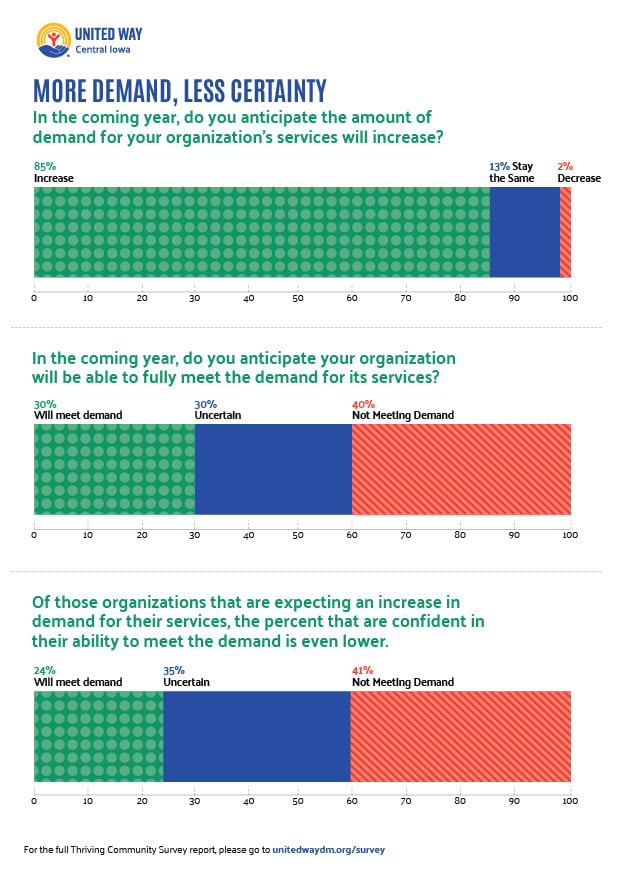
Demand continues to outpace capacity and resources. Most organizations reported increased demand in the past year, and 85% expect demand to increase in the year ahead. Yet only 30% expect to be able to fully meet that demand.
-
Resource gaps hit hardest on households struggling to afford the basics. The report notes that many people served by health and human services nonprofits are living in or near financial crisis. Ninety-six percent of responding nonprofits support ALICE® households - households that are Asset Limited, Income Constrained, Employed - and one in three central Iowa households struggles to afford basic needs.
-
Workforce challenges are a key driver of capacity constraints. Respondents reported challenges employing enough staff for programmatic work, finding staff with the right skill sets, addressing staff burnout, supporting operational and administrative functions, and managing executive director or senior leadership burnout.
-
Organizations are managing through financial uncertainty. The report found that many nonprofits continue to demonstrate careful financial management, with nearly half reporting a balanced budget in their most recently completed fiscal year. At the same time, more than half reported concerns about their organization’s financial stability, and more than four in 10 characterized their current financial stability as weak or fair.
-
Funding streams are shifting. Eighty-five percent of responding nonprofits receive some type of public funding. The report notes that reductions or uncertainty in federal and state funding can affect essential services that are difficult to replace through private fundraising alone. Organizations are also working to diversify revenue, with many pursuing strategies to increase individual giving, grants, corporate gifts, private foundation support, special event revenue and fee-for-service revenue.
-
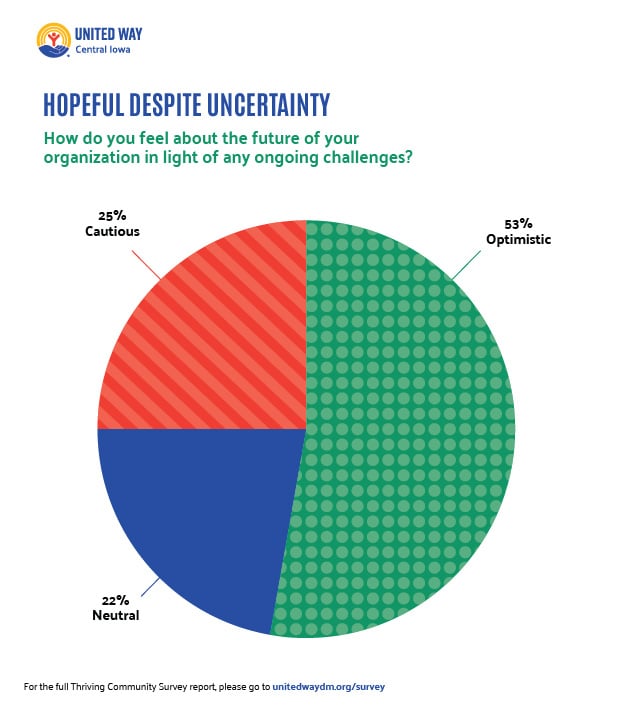
External pressures are impacting nonprofit work. Organizations reported concerns about the well-being and safety of the people they serve, shifts in what they do or how they deliver services, reductions in services, and legal challenges related to the people or issues affected by their work. Despite these challenges, 53% of respondents said they are optimistic about the future of their organization, while 22% are neutral and 25% are cautious.
“Health and human services nonprofits are essential to a thriving community,” said Mary Sellers, president and CEO of United Way of Central Iowa. “These organizations are serving families facing increasingly complex needs, while also managing workforce challenges, financial uncertainty and changes in funding. The survey makes clear that nonprofits are adapting carefully and thoughtfully, but they cannot meet growing demand alone.”
The report emphasizes that helping central Iowa thrive will require coordinated action across nonprofits, government, business, philanthropy, faith communities and residents. It calls for shared investment in community goals, support for the operational capacity behind direct services, stronger connections among service providers, planning for changes in public funding, workforce support, and a community environment where organizations can focus on their missions.
“Central Iowa’s nonprofits are not standing still,” Sellers said. “They are planning, adjusting and working together to continue serving the community. But the path forward requires shared responsibility among nonprofits, funders, businesses, public partners and community members.”
United Way of Central Iowa will use the report to inform community conversations, funding strategies and partnerships aligned with UNITED to THRIVE, its strategic imperative to foster an equitable, engaged and empowered community. The report also calls attention to the importance of investing not only in direct services, but also in the staffing, infrastructure and partnerships that help organizations respond effectively to changing community needs.
The full 2026 Thriving Community Survey Report is available at unitedwaydm/survey.